Expert.ai and Springer Nature Advance AI-Powered Clinical Trial Design on Microsoft Discovery
Protocol Design Intelligence (PDI) brings together scientific literature, clinical-trial evidence and specialized AI agents to advance explainable, evidence-driven clinical research on Microsoft Discovery. Initially focused on breast cancer Trial Similarity, PDI provides an extensible framework for broader pharmaceutical research applications.
Clinical research and AI-powered evidence analysis.
Designing a clinical trial is one of the most consequential steps in drug development. Decisions about patient populations, eligibility criteria, endpoints and study structure can directly affect recruitment, operational complexity, timelines and ultimately a trial’s likelihood of success.
The evidence behind these decisions is distributed across trial registries, peer-reviewed publications, scientific databases and internal research repositories. Different formats and terminology make it difficult to connect insights from the literature with the practical lessons of earlier studies.
What if researchers could move beyond searching individual sources to explore connected scientific evidence, compare trial designs and investigate factors that may contribute to protocol amendments?
That is the ambition of Protocol Design Intelligence, developed by Expert.ai in collaboration with Springer Nature, whose expertise in scientific publishing and clinical research helps shape its development and evaluation. PDI is being deployed on Microsoft Discovery, a platform that connects data, AI models and specialized agents across research workflows, and contributes a clinical intelligence layer that helps development teams interpret historical evidence. The initial Discovery release focuses on Trial Similarity, establishing a foundation for future capabilities in risk-driver analysis and amendment-risk prediction.
Connecting scientific literature and clinical evidence
Expert.ai provides the technology to harvest structured and unstructured information, recognize clinical concepts across publications and trial records, and make that knowledge available for specialized analysis. Springer Nature contributes scientific publishing and clinical research expertise to PDI’s development and evaluation, drawing on more than 40 years of AdisInsight experience and its expert-led approach to clinical trial curation, including assessment of outcomes across 33 criteria to provide deeper insights into the factors associated with trial success or failure.
The harmonization process can follow a pharmaceutical organization’s preferred ontologies, controlled vocabularies and internal standards, particularly valuable when adding proprietary laboratory findings, study reports and other research data.
Different sources may describe the same disease, treatment or endpoint in different ways. Expert.ai uses semantic and neuro-symbolic AI techniques to reconcile these descriptions and connect the resulting knowledge to its source material. This Clinical Development Knowledge Layer supports consistent analysis across datasets.
Researchers can therefore investigate relationships across scientific literature and trial data, rather than interpreting each publication or record in isolation.
“Better clinical trial design begins with connecting trusted scientific evidence to the decisions researchers make every day. By combining Expert.ai’s semantic intelligence and explainable AI with Springer Nature’s scientific publishing and clinical research expertise, we are developing Protocol Design Intelligence to help teams understand why trials are comparable, explore potential design risks, and trace insights to their sources. Deploying these capabilities on Microsoft Discovery creates new opportunities to integrate knowledge and specialized AI agents into adaptable clinical research workflows.”
- Christophe Aubry, Global Head of Life Sciences & Healthcare, Expert.ai, and
Nicole Radewic-Pahl, Vice-President Pharma Solutions, Springer Nature
From Clinical Evidence to Better Trial Design Decisions
Finding relevant studies is the beginning. Research teams also need to understand how closely historical trials resemble a proposed study and which differences matter clinically. Generative AI and retrieval-augmented generation (RAG) can support question answering and summarization; PDI adds a domain-specific knowledge model and analytical methods for comparing study designs.
Its Trial Similarity capability examines studies across disease characteristics, interventions, patient populations, eligibility criteria and endpoints. A weighted similarity methodology reflects the relative importance of these dimensions in establishing clinical comparability, providing researchers with a consistent, clinically grounded basis for understanding why studies are similar or different.
The comparison identifies the dimensions that support a match and those that distinguish the studies, with references researchers can inspect. A chat interface also lets users ask questions across the harmonized datasets and explore related findings in natural language.
This approach supports scientific review: teams can examine the reasoning behind a comparison rather than relying on a similarity score or a standalone generated answer.
For breast cancer trials, PDI’s side-by-side comparison view helps researchers inspect protocol characteristics, endpoints, outcomes and documented design changes.
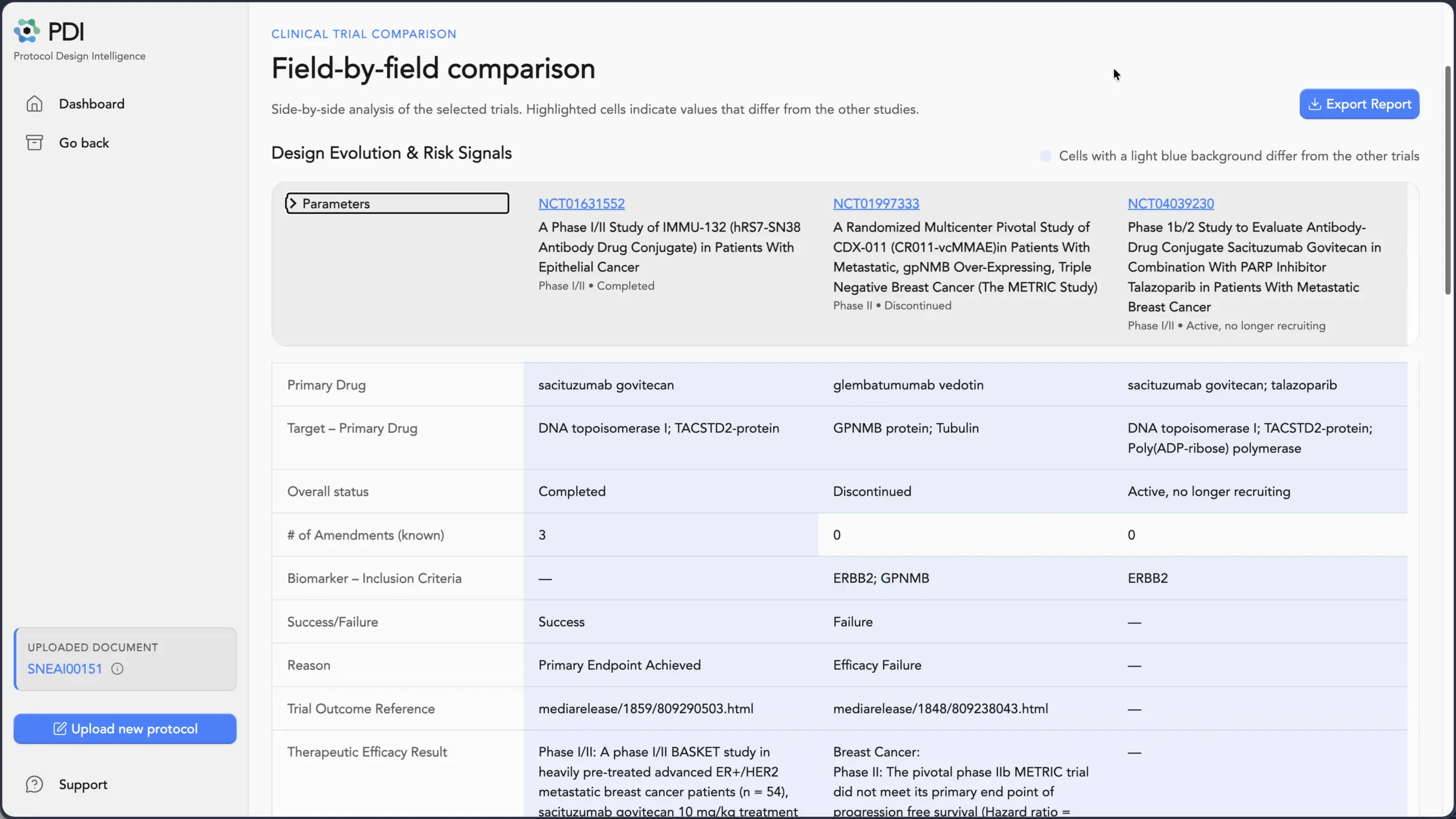
PDI in action: side-by-side comparison of oncology trials, showing protocol characteristics, endpoints, outcomes and design changes. The underlying knowledge models support explainable comparisons and traceability to source evidence. Illustrative PDI interface.
Researchers can move seamlessly between trial comparisons, supporting research and the underlying clinical evidence.
Together, these tools help translate historical research into practical evidence for protocol discussions.
From Trial Similarity to Proactive Design Risk Assessment
Trial Similarity lays the groundwork for a broader objective: recognizing potentially consequential design choices before a study begins.
Historical trials record not only initial protocols but also subsequent changes. Examining these patterns alongside patient populations, eligibility criteria and endpoints may reveal characteristics associated with operational complexity or amendments.
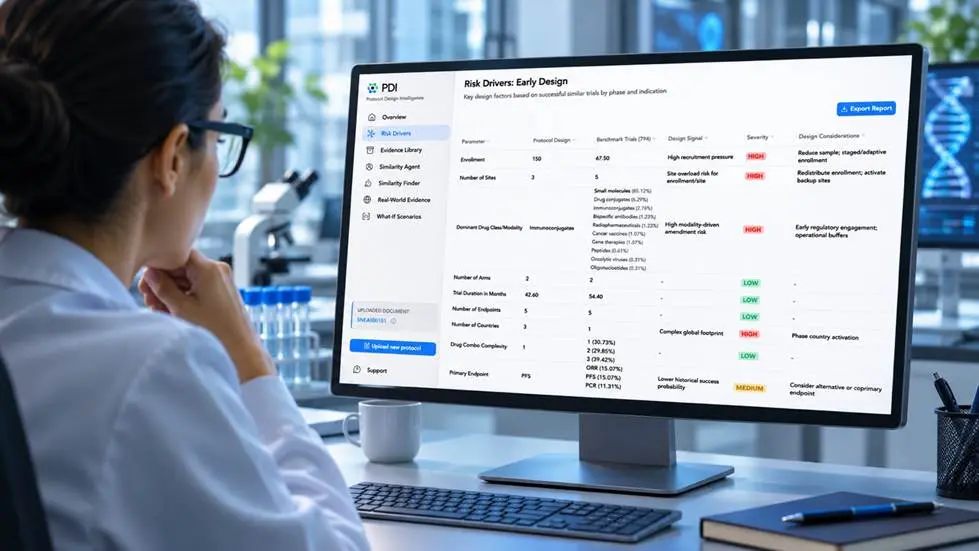
The PDI demonstration explores this direction with risk-driver analysis and an amendment-risk prediction model. The intent is to help researchers investigate how design choices might affect amendment likelihood and consider alternatives informed by historical evidence.
For instance, a team could examine whether restrictive eligibility requirements or particular endpoint choices recur among studies that later required amendments. Such findings would inform protocol review, not replace clinical expertise.
While the initial Microsoft Discovery release focuses on breast cancer Trial Similarity, PDI’s broader development roadmap includes risk-driver analysis and amendment-risk prediction, both demonstrated in the current development environment. These predictive capabilities will require further evaluation before becoming part of a validated production offering. Additional therapeutic areas and what-if scenario analyses are also planned.
Connecting PDI to agentic research workflows on Microsoft Discovery
Microsoft Discovery is designed to connect scientific data, models, tools and intelligent agents across research workflows. Within that environment, PDI is an extensible source of clinical knowledge and analysis, not a closed application or a fixed collection of documents.
Expert.ai’s harvesting and standardization layer is designed to accommodate internal study reports and laboratory data alongside trial registries, scientific publications, licensed publisher content and third-party information. Organizations can apply their own ontologies and terminology conventions as they extend the knowledge base.
Further integrations could include appropriately authorized hospital records and real-world evidence, subject to privacy, consent, licensing and governance requirements. These are potential extensions, not part of the initial release.
Through Model Context Protocol (MCP) services, PDI makes its knowledge and specialized analytical functions available to agents in Microsoft Discovery. These services can be orchestrated with other approved tools and datasets to support research processes tailored to a company’s therapeutic areas and workflows.
“Many clinical trials’ most consequential decisions are made before the first patient is enrolled. Protocol Design Intelligence brings Expert.ai’s explainable AI and Springer Nature’s clinical research expertise to that moment, showing which past trials resemble a proposed study and why. Deployed on Microsoft Discovery, it can work alongside a company’s own data, tools and agents. That is what R&D leaders across life sciences tell Microsoft they need from AI: evidence they can trust, reasoning they can check, and judgment that stays with their experts.”
- Elena Bonfiglioli, Global Business Lead, Health, Pharma and Life Sciences, Microsoft Discovery Cross-Industry Lead, Microsoft
For example, an oncology team could use an agentic workflow to identify comparable studies, examine supporting scientific literature and combine the findings with its own prior study reports. Other teams could configure workflows for different indications or internal review practices. Such broader integrations would be implemented according to customer needs.
Technical demonstrations have been completed in the Microsoft Discovery development application and Microsoft Foundry. Further work will focus on Enterprise validation and extending integration capabilities to support customer-specific research workflows.
Download the Discovery app and try the PDI agent.
Advancing research transformation in pharmaceutical R&D
The opportunity is larger than faster literature searches or document summaries.
Research transformation requires teams to bring together evidence from multiple systems and use it in repeatable, adaptable workflows. Connecting scientific publications with clinical-trial records provides a stronger basis for evaluating protocol choices and exploring new questions.
PDI combines Springer Nature’s domain expertise with Expert.ai’s technology, clinical knowledge engineering and specialized analytics. Microsoft Discovery provides an environment in which those capabilities can be connected to agentic workflows and additional enterprise resources.
The near-term value is clearer, evidence-grounded trial benchmarking. Over time, the ambition is to help researchers recognize design trade-offs earlier and investigate the likelihood of avoidable protocol amendments.
Planned work includes broader therapeutic coverage, authorized internal and external datasets, and further development and evaluation of risk assessment, scenario exploration and protocol optimization capabilities.
The aim is to move from understanding how previous studies were designed toward making better-informed decisions about what to design next.
As PDI is deployed and evolves on Microsoft Discovery, its purpose remains practical: make connected scientific evidence useful within the research workflows pharmaceutical teams already depend on. See Protocol Design Intelligence in action: watch the PDI demonstration